Mesure de performance d'isolation vibratoire - zoom

Blocked Forces

Context & Issue

These “transmitted” forces induce vibrations in the car body, which cause the panels to radiate and generate structure-borne noise inside the vehicles. The analysis of these phenomena is based on the principles of vibration mechanics, in order to understand and predict the propagation of forces and their acoustic impact.

These sound contributions are taken into account by rolling stock manufacturers to estimate overall noise levels in the car body, in addition to airborne noise contributions from outside.

It is therefore essential to characterize blocked forces in new projects, using vibration mechanics methods to optimize vehicle design and acoustic comfort.

Client benefits

01

Measurement method adaptability

Blocked force estimation methods can be implemented in situ (component fixed directly to the train) or on a test bench at the supplier’s premises, depending on project requirements and progress.

02

Agility in data management

Data can be stored in a database that can be used by the equipment or rolling stock manufacturer for new projects.

03

Decision support for recommendations or specifications

Data used to estimate structure-borne noise will enable rolling stock manufacturers to classify different source contributions, and, if necessary, make recommendations to improve certain components (or draw up specifications).

Grateful for their confidence

Challenges for Vibratec

01

Innovation and adaptation to evolving standards

Vibratec must constantly innovate to align its measurement methods with new safety and performance standards, thereby ensuring that its services continue to meet client requirements.

02

Mastery of complex operating conditions

Vibratec’s ability to reproduce extreme operating conditions in its test benches is crucial to providing reliable measurements that are suitable for harsh environments.

03

Personalized support and skills transfer

Offering training and support services allows Vibratec to strengthen its customer relationships by giving them the autonomy they need to better use and understand methods for measuring blocked efforts.

Key Development Points

Identification of blocked efforts in the railway context

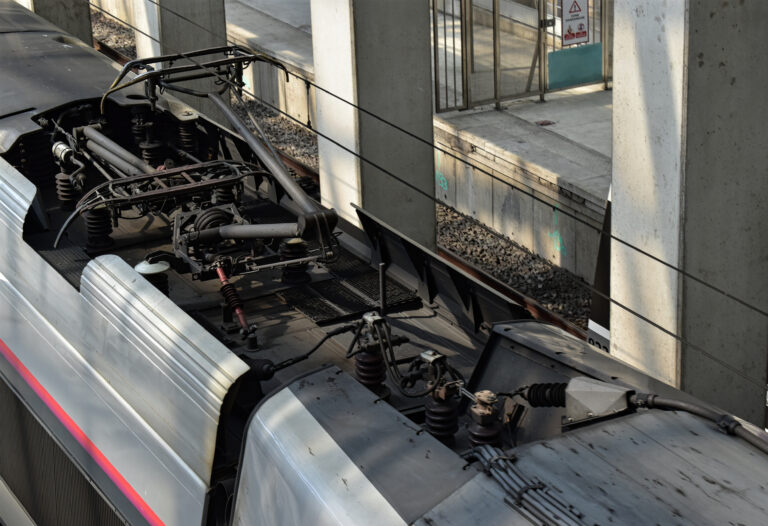
In the railway industry, blocked forces, i.e., residual forces that occur at the contact interfaces between mechanical components (such as bogie interfaces, components, and suspension elements), play a crucial role in interior acoustic quality. These forces can be identified using specific measurement methods.

The indirect method, standardized by ISO 20270:2019, is based on transfer function measurements using an impact hammer and accelerations for the different operating phases. It is particularly useful when force sensors cannot be used directly. In addition, the direct method, when feasible, measures forces using sensors installed at contact points, ensuring greater accuracy (under certain conditions of host structure rigidity).

Measurement methods based on specific processes for the railway industry

Measuring these forces requires the acquisition of precise parameters, such as frequency response functions (installation at standstill with impact hammer loading) and acceleration spectra for different operating conditions for the indirect method, and forces measured directly with force sensors for the direct method. Due to the different entry points and stresses on train bodies, these measurements are critical for analyzing the influence of blocked stresses on acoustic quality and certification. This also allows rolling stock manufacturers to specify blocked stresses for different components (HVAC, electrical equipment, etc.).

Consideration of railway equipment operating configurations

In the railway sector, operating configurations can vary considerably depending on operating conditions. This includes different rotating speeds on component parts (fan, compressor). Measurement tests must therefore take these different conditions into account to ensure that the forces measured are representative of operating situations.

Structural rigidity for accurate force measurements

Finally, for accurate direct measurements, when using direct methods to measure force, the test bench mounting structure must be sufficiently rigid within the frequency range relevant to railway equipment. A rigid mounting structure ensures that the force sensors only record forces that are not disturbed by support modes. Rigidity is therefore a key requirement in test benches for direct methods.

This is not the case for indirect measurement methods: measurements can be taken directly on the train or on a test bench without any particular constraints.



Results & Benefits

01

Knowledge of the forces generated and estimation of the levels of structure-borne noise induced by the component inside the train

02

Solution sizing (filtration, structural reinforcement) to reduce component contributions

03

Creation of a database that can be used for future projects

04

Raising awareness among equipment manufacturers on these issues

Want to know more ?

Contact us

    protection par reCAPTCHA