Roof Tile Quality Control Using Acoustics

Improving the reliability of your industrial quality control

Improving crack detection reliability at the end of the production line

Development of a non-destructive acoustic quality control system for roof tiles

As part of its roof tile inspection process, our client implemented an automated acoustic material inspection system designed to detect cracks in its tiles at the end of the production line.

After two years of production testing, the company sought to validate the system’s performance compared to manual operator inspections before full-scale deployment.

Our work at the Commenailles site enabled us to analyze discrepancies, identify the system’s limitations, and propose concrete technical and methodological recommendations.

Context & Issue

End-of-line quality control was previously performed by a qualified operator who randomly selected tiles from each batch.

Vibratec offered a solution for 100% end-of-line tile inspection using its equipment.

The goals were clear:

  • Inspect 100% of the tiles produced,
  • Automate the detection of defects such as internal cracks,
  • Isolate potentially defective tiles,
  • Focus the operator’s expertise on the identified sample(s).

This protocol aims to enhance the reliability of quality control while maintaining a high level of productivity.

Client Benefits

01

A reliable system

Ensure a detection rate at least equivalent to manual inspection, the company’s historical benchmark

02

Optimized control

Control the over-detection of micro-defects to prevent an increase in the scrap rate and thus a direct economic impact

03

Fewer uncertainties

Improve the reliability of the automated decision-making process to reduce uncertainty regarding so-called “disputed” tiles

04

A robust system

Verify the system’s technical robustness with respect to manufacturing tolerances

The Game Changer

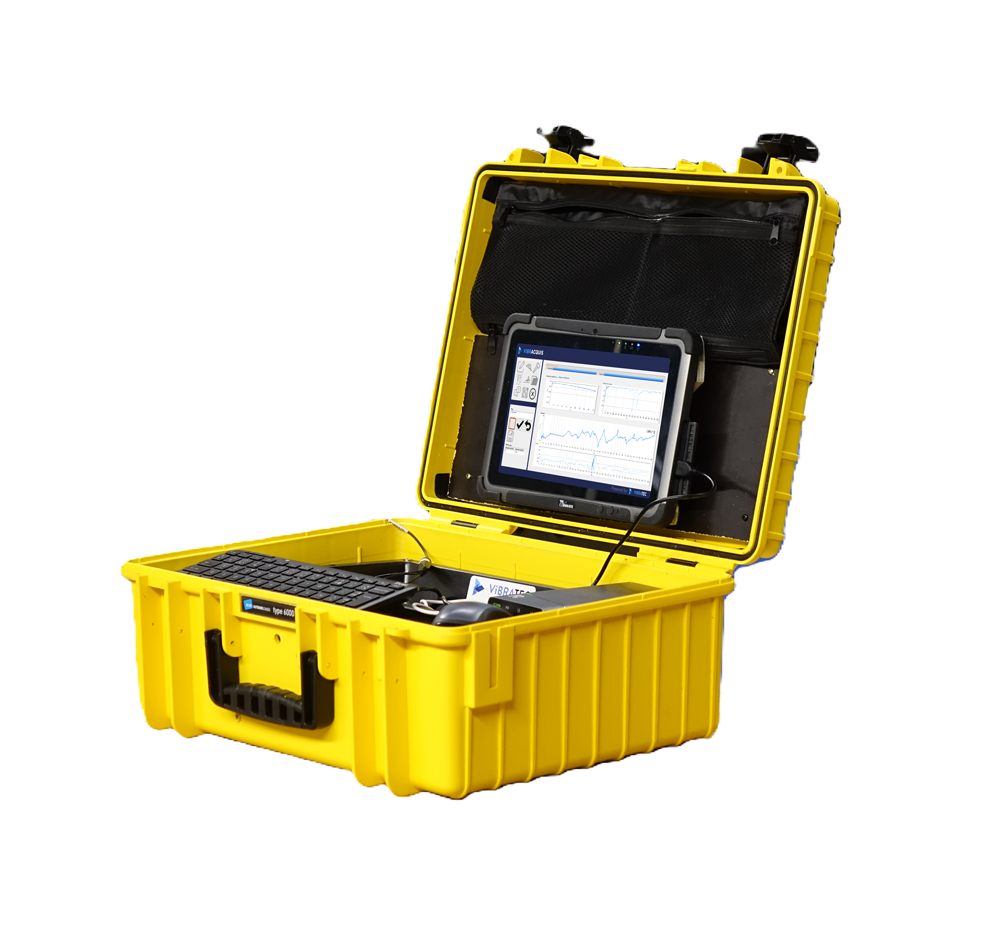
The VibrAcquis® Turnkey Acoustic Measurement Kit

Our mission was to define a reliable and repeatable measurement protocol and to conduct a detailed result analysis in order to formulate operational recommendations.

VibrAcquis® enabled:

  • Improvements to the test protocol.
  • A detailed analysis of discrepancies between the system and operators.
  • Verification of acquisition and processing parameters.
  • Recommendations for hardware improvements (impact hammer, micro-enclosure).

View the product sheet


vibracquis analyse acoustique

Structuring the Test Protocol and Ensuring the Reliability of Observations

On the first day of testing (8 stacks of 240 tiles), discrepancies emerged between the system’s decisions and those of the operators. Despite the presence of several participants, it proved difficult to pinpoint the exact causes of the discrepancies: a poorly stamped tile, a missing tile in a row, an identification error, or a genuine disagreement regarding the tile’s condition.

This finding highlighted a methodological issue: without precise visual traceability, the analysis remained partially interpretive.

Therefore, for the second day of testing, we added a camera that continuously filmed the tiles on the conveyor belt. This improvement made it possible to:

  • Identify incomplete rows (missing tiles).
  • Exclude poorly stamped tiles from the analysis.
  • Precisely locate each tile (12 per row).
  • Systematically cross-check system and operator results.

This step was crucial to objectively quantify discrepancies and move away from a subjective assessment in favor of factual analysis.

Comprehensive Verification of the Data Acquisition and Processing Chain

In light of persistent discrepancies (e.g., the operator detected 13 defective tiles in a stack, while the system detected 20), a comprehensive review of the technical parameters was conducted.

The following points were validated:

  • The acquisition and processing speed was greater than the speed at which the tiles were passing by.
  • The synchronization between the mechanical impact and the acquisition was correct.
  • Each file corresponded strictly to a single tile (incremental timestamp, no mixing possible).
  • The rectangular acquisition window was suitable for the impact-type signal.
  • The window centering and spectrum shift had no significant impact on the results.

This technical audit phase ruled out the possibility of a major hardware or software malfunction. The discrepancies did not stem from a flaw in the measurement chain, but rather from the system’s sensitivity on certain borderline tiles.

Identifying a Buffer Zone: the “Yellow Light” Strategy

The in-depth analysis showed that the system worked very well at eliminating “clearly defective” tiles. Difficulties arose with very minor defects, such as microcracks or firing defects that had only a slight impact on the frequency spectrum.

These tiles fell into an intermediate zone, close to the decision threshold between compliant (green) and non-compliant (red). To address this issue, we proposed establishing a “yellow” zone around the decision threshold (for example, between 12 and 14 for a threshold set at 13).

This zone accounted for approximately 10% of the tested tiles.

The adopted principle:

  • Tiles that are clearly compliant or non-compliant continue to be processed automatically.
  • Tiles in the yellow zone are flagged to the operator for additional manual inspection.

A test was conducted to modify the high-frequency (HF) weighting, an area sensitive to small cracks. However, adjusting the coefficients did not yield a sufficiently conclusive improvement without risking the distortion of all measurements.

The strategic decision was therefore to retain the main calculation and introduce targeted human inspection for ambiguous cases.


Recommendations for Physical and Environmental Improvement

In addition to the software analysis, technical recommendations were made to enhance the system’s overall robustness.

We recommended:

  • Improvements to the impact hammer (currently a prototype), specifically by eliminating any possible rotation of the tip to ensure perfect impact reproducibility.
  • Better control of the descent and mechanical retraction.
  • The installation of a microphone housing to make the measurement more directional and reduce the influence of background noise in the workshop.

These optimizations aim to reduce external variability and improve measurement stability in a noisy industrial environment.

Combining Technical Expertise with Hands-on Experience

This on-site assessment at the client’s facility led to a clear conclusion: the acoustic inspection system is effective at detecting major defects and is technically robust. The discrepancies observed compared to manual inspection mainly concern borderline cases that are difficult to resolve even for an experienced operator.

The implementation of a “yellow” zone represents an effective compromise between automation and human expertise. It maintains a high level of quality while avoiding an excessive increase in the scrap rate.

This project perfectly illustrates the importance of an approach combining technical audits, field analysis, and pragmatic adjustments to successfully integrate an automated inspection system into a demanding industrial environment.

Want to know more?

Contact us

    protection par reCAPTCHA