
The Sonic Sense is a general-purpose IoT sensor for acoustic and vibration detection. Its embedded algorithm can be configured to recognise different spectral signatures depending on the phenomenon being monitored. In the context of a study carried out for an urban public transport operator, Vibratec configured and validated the Sonic Sense for a specific use case: the automated detection of tram squeal on curves, building on the findings of an acoustic measurement campaign conducted upstream.

Sonic Sense: Rail Curve Squeal Detection
Configuring a generic IoT sensor for automated tram squeal detection in an urban environment.
Configuring a generic IoT sensor for automated tram squeal detection in an urban environment.

Sonic Sense Ferro
Continuous acoustic monitoring
Sensor
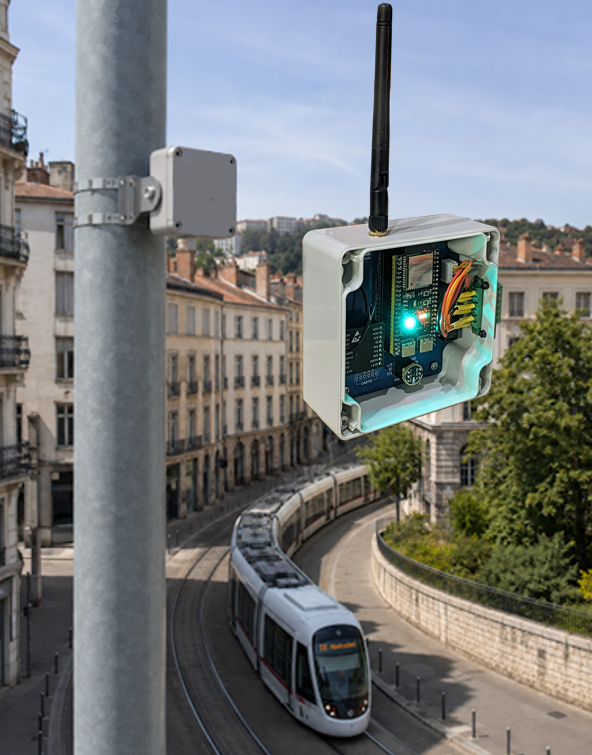
Sonic Sense, configurable IoT acoustic detection platform
Approach
Measurement campaign → algorithm tuning → field validation
Key figures from the characterisation campaign
100 %
Of passes produced squeal on the most critical curves
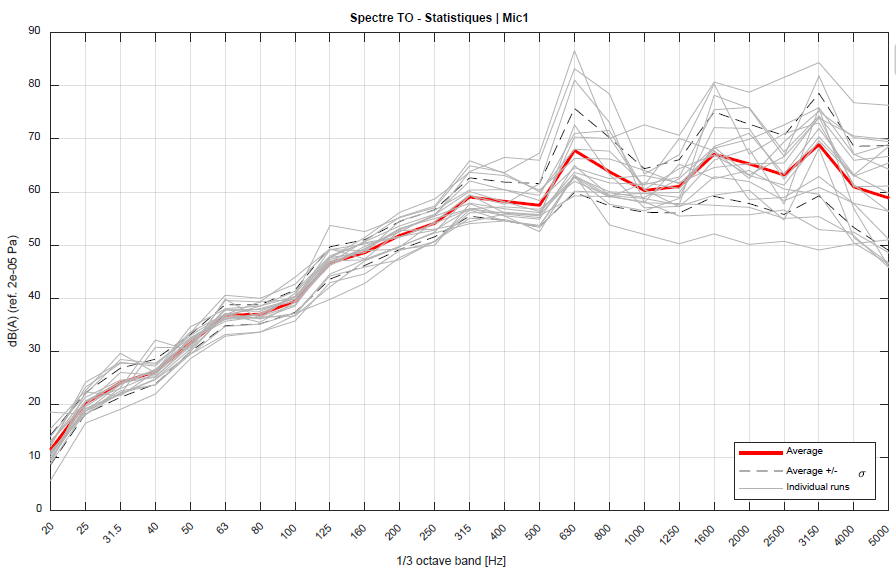
96–100 dB(A)
Peak acoustic pressure levels recorded
630 Hz
Dominant frequency in the squeal spectral signature
Morning
Time window with the highest concentration of events
1 – Acoustic characterisation of the reference phenomenon
At a glance
- Microphone placed 3.5 m from the track, at the target Sonic Sense installation points
- Measurements taken on un-lubricated track under documented weather conditions
- Almost all tram passes generated squeal on the most critical curves
- Acoustic pressure levels between 96 and 100 dB(A)
- Spectral signature identified,input parameter for the Sonic Sense algorithm
Before any sensor configuration, an acoustic characterisation phase was carried out on the critical curves, at the locations corresponding to the planned Sonic Sense installation points. A microphone and accelerometer were used to record the full signature of the phenomenon on un-lubricated track, under rigorously documented weather conditions.
One-third octave spectral analysis revealed a characteristic signature centred at 630 Hz, with secondary components at 1600 Hz and 3150 Hz. This signature provides the key input parameter for configuring the Sonic Sense recognition algorithm for this specific use case.
2 – Algorithm validation through continuous on-site monitoring
At a glance
- Sensor installed in real operating conditions, configured from the identified signature
- Continuous acquisition: microphone, accelerometer, remote data transmission
- Events detected and timestamped in line with initial configuration
- Detections concentrated in the morning, correlated with residual humidity
- Acoustic configuration confirmed as relevant
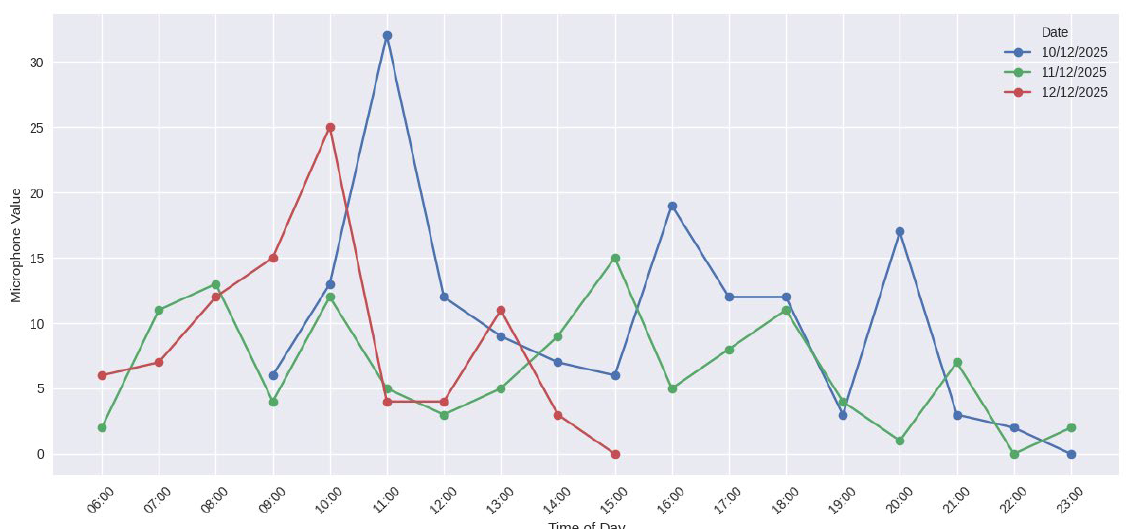
Once the acoustic signature had been characterised, a prototype configured with these parameters was installed on site to validate detection under real operating conditions. The device ran continuously over several consecutive days, transmitting each detected event remotely.
The results confirm the relevance of the configuration: detected events follow a temporal pattern consistent with the phenomenon observed in the field. This phase validated the sensor’s ability, once configured, to reliably detect the target phenomenon under real-world operating conditions.
3 – Sonic Sense: a reconfigurable acoustic measurement sensor
At a glance
- Sonic Sense is a general-purpose IoT sensor for acoustic and vibration detection
- Its embedded algorithm can be re-parametrised to match any target spectral signature
- Rail squeal detection is one configuration among many possible applications
- The same hardware can be redeployed for other acoustic target events
- Automated alerts and supervision reporting regardless of the configuration
Sonic Sense is an acoustic detection sensor built on a generic IoT platform. Its signal processing algorithm is designed to be re-parametrised for any target phenomenon, rather than being locked to a single use case. Tram squeal detection, as presented here, is one configuration among many possible applications.
Once the acoustic signature of a phenomenon has been characterised — as was done here for curve squeal — the same sensor can be deployed to monitor other acoustic or vibration events, subject to re-parametrising its embedded algorithm. In all cases, the operating logic is identical: real-time detection, alert sent to the corrective action control system, and event reporting to supervision.
Other possible sensor configurations
Equipment vibration monitoring
Detection of abnormal vibration signatures on rotating machinery or structures, as a complement or alternative to acoustic detection.
Industrial acoustic event detection
Identification of sounds characteristic of a fault (friction, impact, leak) on a production line or critical equipment.
Environmental acoustic monitoring
Tracking of intermittent or recurring noise nuisances in urban or industrial environments, with automated alerts based on configured thresholds.





Want to know more?
Contact us